
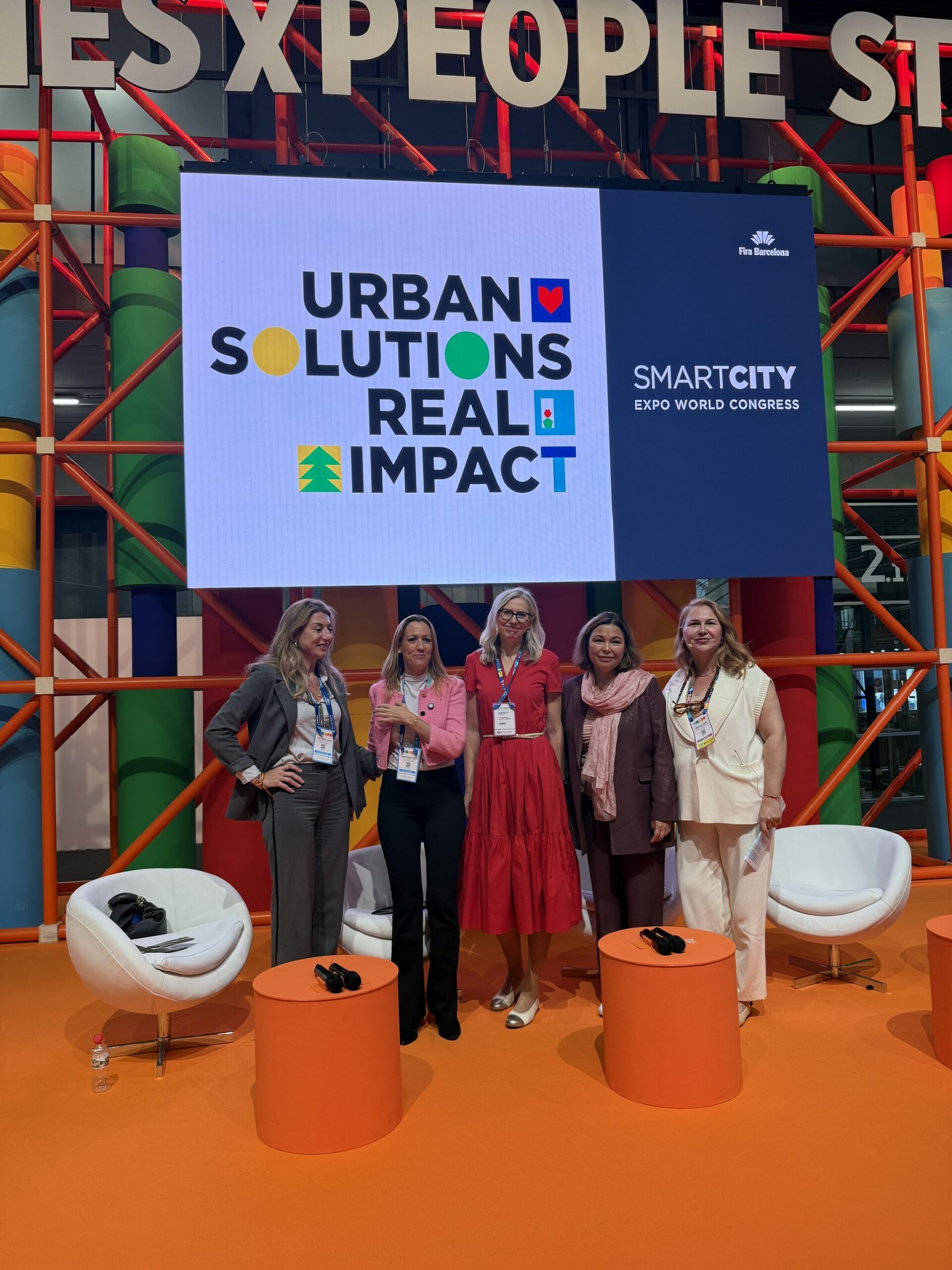
Women are half the city by population, but at the leadership level the picture is far worse: only around 5% of mayors worldwide are women.
That’s what we discussed at Smart City Expo World Congress in our panel “Half the City – Why women’s leadership is the missing key to smarter urban futures”, with Mª Eugenia Gay Rosell, Lola Ortiz and Ayumi Moore Aoki, brought together and moderated by Svetlana Tesic. With many conference stages quiet this year, a full house showed that the topic matters.
Our founder Margot Roose’s key message: it’s not enough for cities to open their doors to innovation. We have to ask who gets to define the problems and who gets to solve them.
One of the sharpest moments came from the audience: decisions are often made on historic data, and that data is often gender-biased. So how do we solve that?
Her answer from experience: when a decision doesn’t take everyone into account, communities step in. In Tallinn, the city had to reverse a decision on a new bus route because it didn’t serve children’s journeys to school, even though the data suggested otherwise. The data reflected the majority, not everyone.
The lesson: data alone isn’t enough. Bring the people who live the city into the room before the decision, not after.
Voices from the panel
Cities are designed, funded and governed by decisions. What happens when half the city is missing from it?
Svetlana Tesic, Alliance of European Mayors, who brought the panel together and moderated it
Svetlana took one audience question home with her: how do we change the future of our cities if technology, the great enabler, is still largely shaped by men?
The more women take part in decisions about mobility, the wider our view of how we move.
Lola Ortiz, Director General for Mobility Planning and Infrastructure, City of Madrid (translated from Spanish)
Lola’s example: think of someone who drops a child at school, changes buses twice to get to work and, on the way home, detours to care for a relative. Plan each journey separately and you lose sight of how hard it is to fit them all together. Mobility is a right, she argued, and being able to use it safely and independently shapes access to work, education and services. It’s why she co-founded Witam, which gives visibility to women’s talent in transport and mobility.
A smart city puts innovation at the service of people and their rights, and ensures that women have a voice and the power to shape our collective future.
Mª Eugènia Gay Rosell, Deputy Mayor of Barcelona
Mª Eugenia also stressed that cities need a stronger voice on the international stage, to drive solutions, strengthen cooperation and defend human rights, with Barcelona contributing through initiatives such as Mayors for Housing.
Well-being in a city starts with feeling safe, whether walking home at night, waiting for a bus or taking the metro.
Ayumi Moore Aoki, Founder & CEO, Women in Tech Global
Thank you to Florencia P. Gannio for setting the stage, and to Mayors of Europe (Alliance of European Mayors), Women in Tech Global, the City Council of Cerdanyola del Vallès and Ayuntamiento de Madrid.